“Madame Grès Never Did Fashion; She Drove Fashion”—A Show of Her Work Is Opening at SCAD
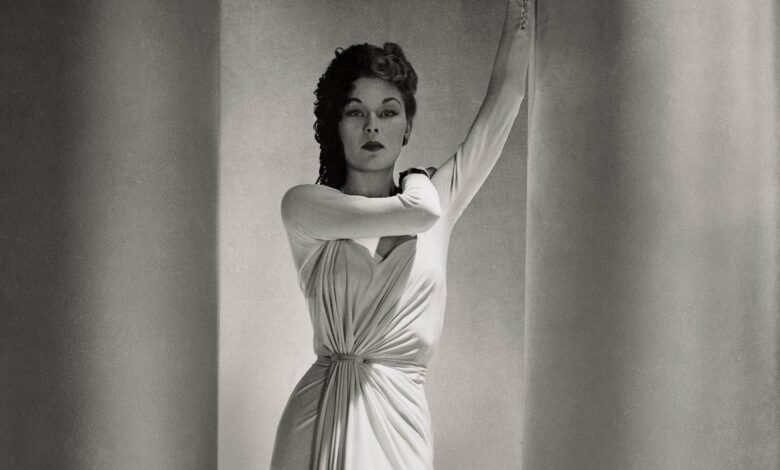
Grès is best known for her Hellenic dresses, but the timelessness of her designs is not only a function of their classicism; they remain modern in part because the designer’s chief preoccupation was the body; her second, fabric. The vagaries of trends were of little interest to her. Moreover, Grès trained as an artist and was, Saillard observes, “much more a sculptor than fashion designer.” His assessment is in line with Vogue’s view of the designer. “It is Alix—Alix with the soul of a sculptor and a talent for draping new to Western civilization—who is the talk of Paris. The drapery of this young newcomer to the Grande Couture is firing a shot that will be heard around the fashion world,” the magazine enthused in 1935.

From the Vogue archive: Edwina d’Erlanger in a chiffon dress by Alix .Photographed by Horst P. Horst, Vogue, February 15, 1936

From the Vogue archive: Model in a Directoire-style dress by Alix. Drawing by Carl Erickson, Vogue, September 15, 1937
Born Germain Barton in 1903, she apprenticed with Premet in Paris, and worked under the name Alix Barton until joining Maison Alix in 1934. In 1940, she parsed her husband’s name to Grès and established her own maison on the rue du Paix where she worked until her reluctant retirement in the 1980s. Saillard met the designer at the end of the career, but says, “ I was not very passionate about Madame. During the ’70s, she was an old-fashioned designer compared to Issey Miyake or to Karl Lagerfeld or to Yves Saint Laurent,” he says. In his then-role at the Musée des Arts Décoratifs, the curator was present on the fateful day in 1987 when the house was liquidated, there to collect garments that otherwise would have been destined for the trash heap. “That day,” Grès’s daughter Anne would later say, “they had stolen her life.” (Subsequently, Anne would hide her mother’s death in 1993; it was revealed more than a year later, months after the Costume Institute opened a Grès retrospective.)
Saillard was reintroduced to the designer in 2010 when he became the director of the Palais Galliera, which was being renovated, the curator dramatically exhibited Grès’s work among the statuary in the Left Bank’s Musée Bourdelle. Since then, says Saillard, “I see Madam Grès always as an angel for me; in every moment I need to do something, Madam Grès is coming. Now in Atlanta, she’s with me.”


