Napa students make mask art for school installation
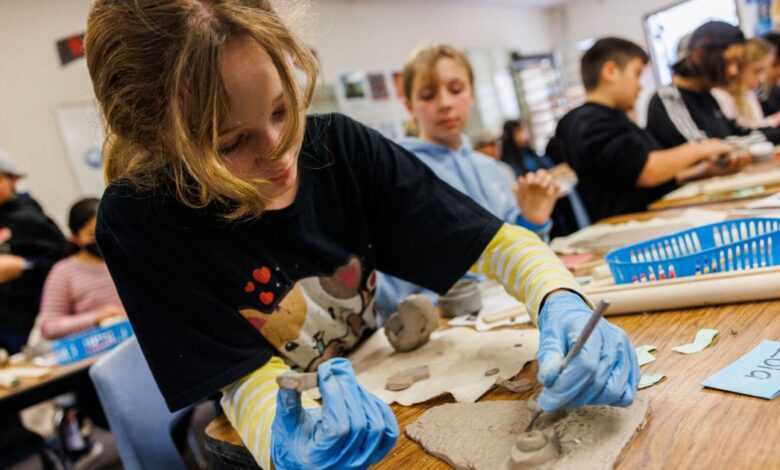
Switching from the classroom to the clay room, fifth-graders at Bel Aire Park Elementary School in Napa are creating their own permanent art installation on campus, while also recognizing Black History Month.
Support local news coverage and the people who report it by subscribing to the Napa Valley Register.
The project is being led by Bel Aire’s ceramics teacher, Pam Imbach.
Imbach, who has taught in the Napa Valley Unified School District for 36 years, said she was inspired by the Black ceramic artist Kimmy Cantrell, who lives in Atlanta.
According to artsy.net, Cantrell is known for colorful ceramic masks “depicting expressive asymmetrical faces with exaggerated eyes and whimsical features.”
“What spoke to me about him is that he says he wakes up every morning excited about (creating) something beautiful that gives him joy,” said Imbach. “So we want them to find that feeling … maybe in art and clay.”
People are also reading…
“He makes beautiful, beautiful masks,” said Imbach. “We want to pay homage to him. … We are focusing on finding joy in our work and celebrating what interests us as a vehicle to that end.”
The teacher said her goal for the students is to learn about Cantrell’s background, “his creative spirit and his impact.”
After studying Cantrell’s work, the Bel Aire students are now creating their own face masks with clay. After they are done, the masks will be displayed as a “legacy installment” in the school library.
The project also coincides with the fifth-grade international baccalaureate exhibition unit where students choose a project to take action in the community, she added.
On Feb. 2, dozens of fifth-graders began working on their own masks. Using a thin slab of clay, each student cut a shape for their face, as well as eyes, eyebrows, mouths and noses.
Bel Aire fifth-grader Reese Jensen said the mask project was “cool.”
“I like shapes” that are seen in Cantrell’s work, Reese said. The student also likes how clay can be shaped and molded over and over. With clay, said Reese, “if you mess up it doesn’t really matter, because it’s art.”
Kailani Medina-Poueu, another fifth-grader, said she was inspired by the way Cantrell places the parts of the face on the clay — not symmetrically. Like the artist, “I want the eye levels to be different,” she said.
It’s fun to create art that will be permanently displayed on campus, said Kailani. She will leave Bel Aire with many special memories and “I want people to remember me” as well, she said.
Fifth-grader Gracie Giusto said she remembered making butterflies and mugs in the Bel Aire clay studio when she was a younger student. The mask project was fun but also challenging in some ways, she said.
“I feel like it might be a little hard for me being a perfectionist about a lot of stuff,” she admitted.
What if her mask doesn’t turn out like she hopes it does? That might be disappointing. Yet at the same time, she didn’t want to just make a copy of one of Cantrell’s masks. Instead, she said, “I’m taking ideas” from his work to come up with her own creation.
Fifth-grader Sam Hickman said that he was inspired by the way Cantrell used nontraditional shapes for parts of his faces. For example, the mouth of one mask is made up of one square on top of the other. “You don’t really see pictures with a mouth like that” in other art, Sam said.
Why did he think Cantrell used blocks like that? “Is it a robot theme?” the student wondered.
Jacob Nguyen worked on a mask that featured a curvy “unibrow” above two eyes. Jacob said he was thinking of Dwayne ‘The Rock’ Johnson, who is known for his expressive eyebrows. If anyone asks, “I know how to explain,” who inspired him, said Jacob.
Fifth-grade teacher Leanna Alcayaga said she loved seeing how the students responded to the project.
“It makes a big difference,” said the teacher. “When they’re doing what they want to do, it keeps them more engaged.”
Alcayaga also likes how working in the clay studio helps highlight other attributes of her students.
“Everyone has their strengths and weaknesses,” and some of those strengths aren’t always seen in the academic classroom setting, she said. “It’s just fun to see” how each student expressed themselves.
The teacher said that the idea of the art being permanently displayed is particularly meaningful. “Every time we look at it we’re going to think about this group of kids,” said Alcayaga.
Photos: Napa students go from the classroom to the clay room

Fifth-graders at Bel Aire Park Elementary School in Napa begin the process of designing a clay mask as part of an art project recognizing Black History Month.
Bel Aire Park fifth-grade students in Napa begin the process of designing decorative clay masks as part of an art project recognizing Black History Month.
Bel Aire Park fifth-grader Lola Anderson, 11, begins the process of designing a clay mask as part of the Napa elementary school’s art project recognizing Black History Month. The finished products will go on display in the school library.
A Bel Aire Park fifth-grader begins the process of designing a clay mask as part of an art project recognizing Black History Month.
Bel Aire Park fifth-grader Lena Scott, 10, begins the process of designing a clay mask as part of her class’ art project recognizing Black History Month.
Bel Aire Park Elementary School fifth-graders in Napa begin the process of designing clay masks for eventual display in the school library, part of a project celebrating Black History Month.
Bel Aire Park fifth-grader Kailani Medina Poueu, 11, begins the process of designing her clay mask.
Bel Aire Park ceramics teacher Pam Imbach works with fifth-graders at the Napa school as they begin the process of designing a clay mask as part of an art project recognizing Black History Month.
A Bel Aire fifth-grader in Napa begins the process of designing a clay mask. The masks were inspired by the work of the ceramicist Kimmy Cantrell.
Lola Anderson, an 11-year-old fifth-grader at Bel Aire Park Elementary School in Napa, begins the process of designing a clay mask as part of an art project recognizing Black History Month. The masks will be permanently displayed in the school library.
Photos: For more photos of the art project, point your smartphone camera at the QR code, then tap the link.
You can reach reporter Jennifer Huffman at 707-256-2218 or jhuffman@napanews.com